Skip to content

Research lab · Full Self-Flying · est. 2026

Wisdom,
in flight

Nyansa Labs is building toward Full Self-Flying, in the open. Our first aircraft, Maame, has no RC transmitter: a companion computer and our own ground station fly it. It took off for the first time on 16 November 2026.

from unboxing to first flight
23 days
RC transmitters on board
0
simulator test suites run before every change
9
custom PCB designed in-house
1

Why we exist

Nyansa is Twi
for wisdom

We study how small aircraft can make safe decisions by themselves, and we publish the hardware and software so anyone can build on it.

  1. 01

    Safety-first autonomy

    With no RC link, the failsafes are the safety net. Every flight passes a gate of checks, and every command is cryptographically signed.

  2. 02

    Open hardware

    Our carrier board, 3D-printed parts and ground station are public. See exactly how it was built, then fork it.

  3. 03

    Built for real work

    Smart Flight tasks for farms, inspection, delivery, search and rescue: flown by the aircraft, not a pilot.

Meet the brain · MaameDrone V1.0

We designed
our own board.

One PCB joins the flight controller (reflexes) to a companion computer (judgement). Scroll to tour it.

  1. J1 · J23Flight controller socket

    The Kakute H7 sits here, pad for pad. ArduPilot gives the aircraft its reflexes.

  2. U1Companion computer

    A Raspberry Pi Zero W handles the thinking: link routing, the launch gate, and the phone app.

  3. U2 · L15 V power stage

    A 3.5 A buck converter turns the 6S battery into clean 5 V for the Pi and peripherals, with fuses and TVS protection.

  4. J8 · J9Radio and GPS ports

    A SiK telemetry radio on UART4 and an M10Q GPS on UART6, plus spare ports for sensors and servos.

Real KiCad export · 95 × 116.5 mm

Maame series · build log

From a box of parts
to first flight.

24 Oct → 16 Nov 2026 · 23 days

  1. The airframe arrives

    An S500 frame and four 3115 900 kV motors: a stable, roomy quad with space for a companion computer and payload.

    Technical detail +
    • S500 frame with carbon arms and landing gear
    • 3115 900 kV motors sized for a 6S battery
  2. Power, soldered

    We soldered the ESCs and assembled the frame, one joint at a time.

    Technical detail +
    • Four ESCs on the arms
    • Battery leads sized for 6S current
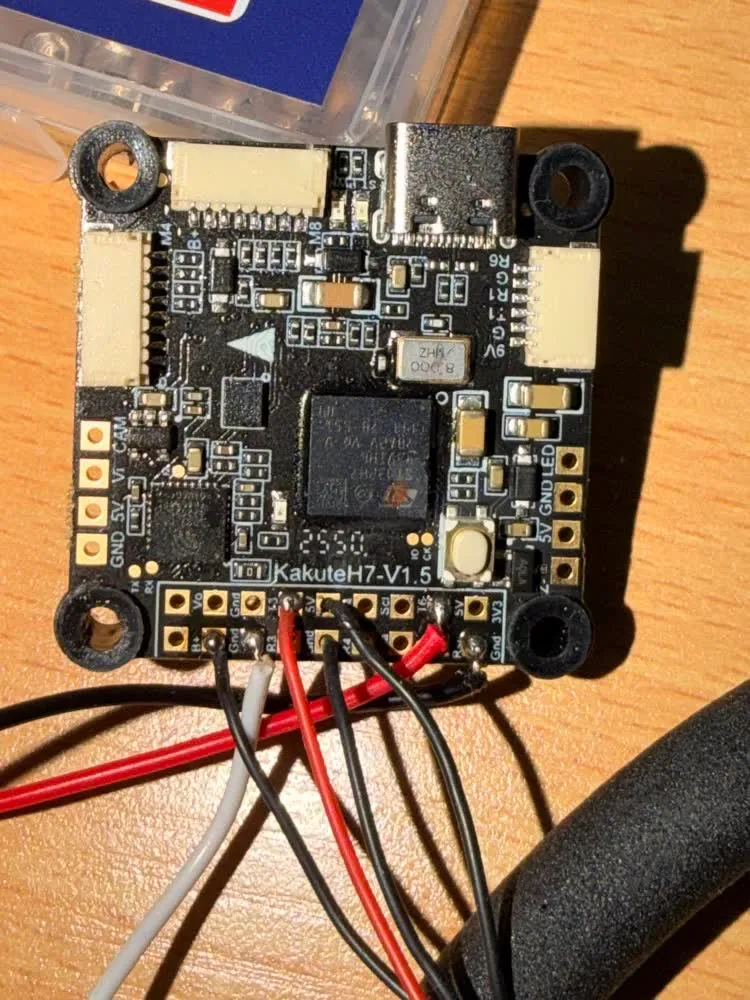
  3. Kakute H7 flight controller with its first wires attached

    The flight controller

    We wired the Holybro Kakute H7 running ArduPilot ArduCopter: the reflexes of the aircraft.

    Technical detail +
    • M10Q GPS and compass on UART6
    • Later, a GPS dropout was traced to an unsoldered header and fixed
  4. Our own carrier board

    MaameDrone V1.0 is a custom PCB designed in KiCad. It joins the flight controller to a Raspberry Pi Zero W so the drone can think on board.

    Technical detail +
    • Pads match the Kakute H7 one-to-one
    • Power, GPS, telemetry radio and Pi on one board
    • Gerbers, BOM and assembly notes are open
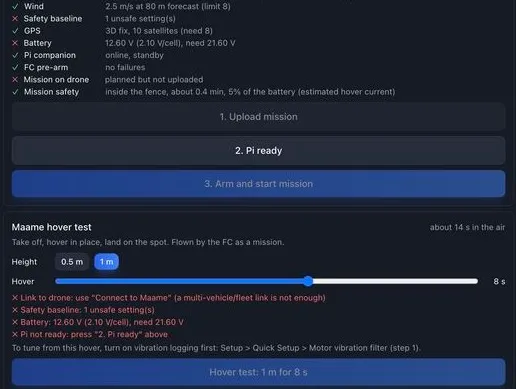
  5. The launch checklist in MaameDrone-ArduDeck

    A ground station with no RC

    We forked ArduDeck into MaameDrone-ArduDeck, adding launch, emergency and mission control over Wi-Fi and SiK, plus a phone app.

    Technical detail +
    • Pre-flight gate: battery, GPS, fences, wind forecast
    • Signed MAVLink: only our station can command the drone
    • Links fail over; commands go out on one link only
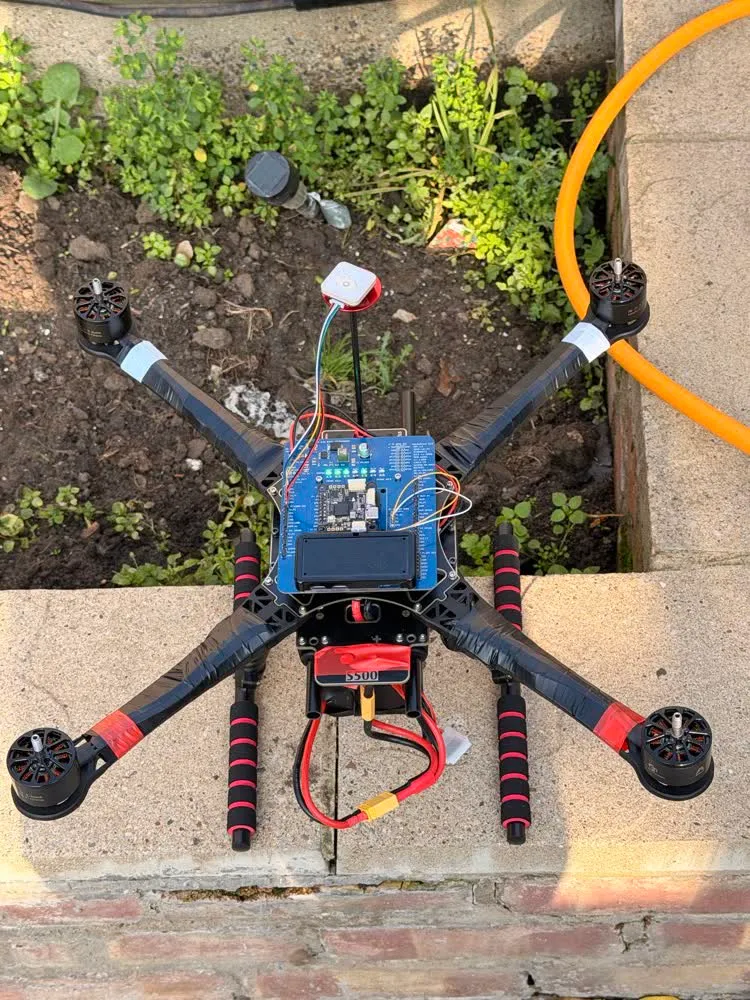
  6. The nearly finished drone on a garden wall

    Almost there

    We fitted the 3D-printed damper tray and electronics case. One lesson cost us a set of props: CW and CCW matter.

    Technical detail +
    • Vibration dampers between frame and electronics
    • Props matched to motor direction (M1/M2 CCW, M3/M4 CW)
  7. Props-off motor test

    We spun each motor alone while the ground station measured vibration. This is the last check before the props go on.

    Technical detail +
    • Motor order and direction confirmed
    • Vibration verdict shown live in the ground station
  8. First flight

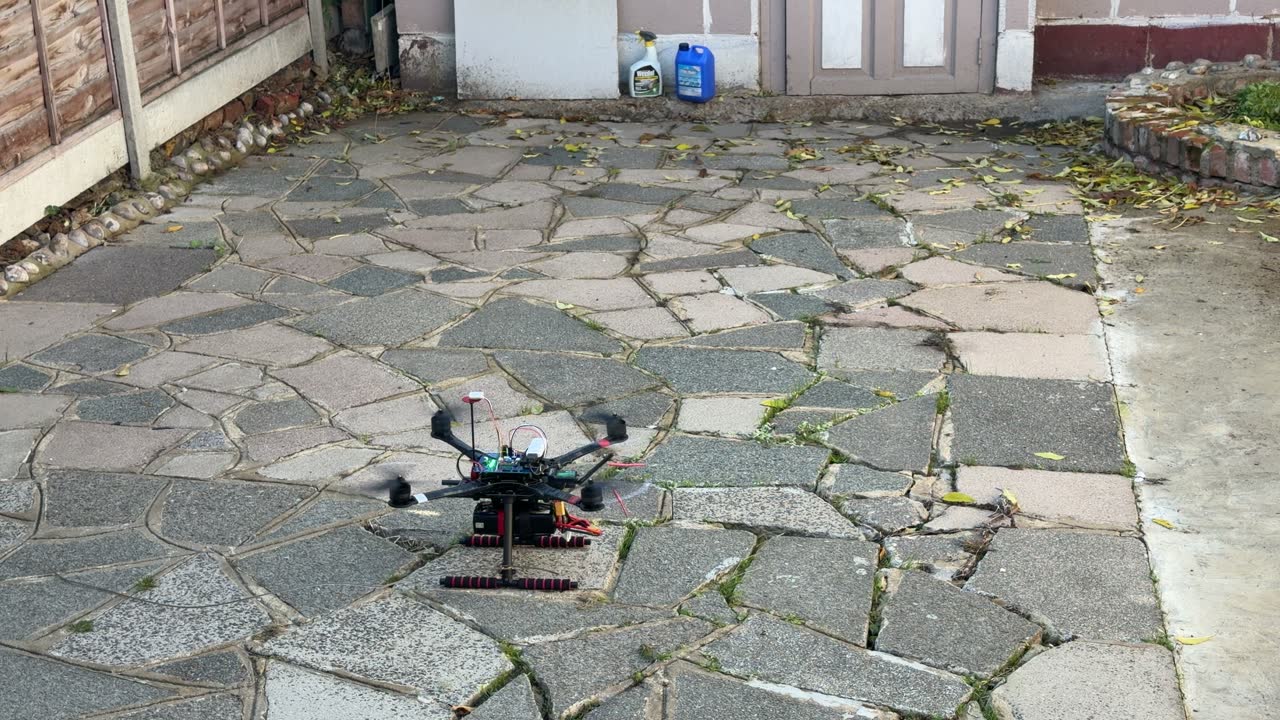
    Maame lifted off and held a low hover, flown from our ground station with no RC transmitter in the loop.

    Technical detail +
    • Hover test card: arm, climb to about 1 m, hold, land
    • Flight logs feed the hover-current and endurance model

What Maame is made of

Proven parts,
our own brain

We use off-the-shelf parts where they're proven and build our own where it matters. All of it is checked in simulation before it flies.

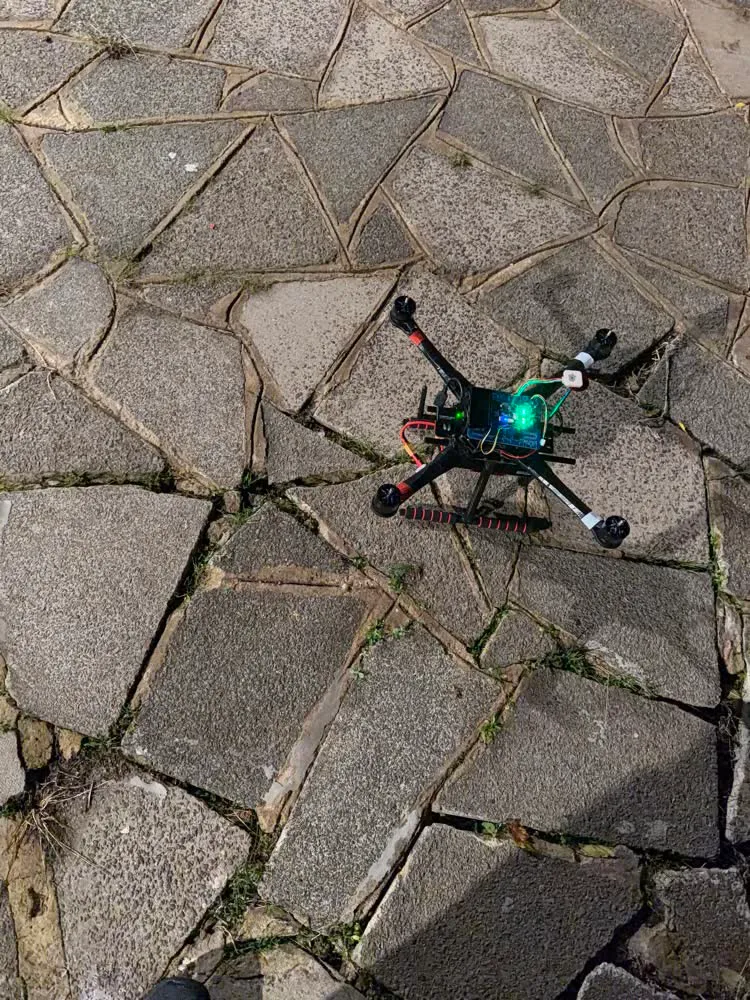
Maame on a stone path, viewed from above

Spec sheet

Maame-01

Frame
S500 quadcopter
Motors
3115 900 kV × 4
Power
6S, 10 Ah
Flight controller
Kakute H7 · ArduPilot
Navigation
M10Q GPS + compass
Companion
Raspberry Pi Zero W
Links
Wi-Fi · SiK · 4G (next)

Simulator first

Every change runs against ArduPilot SITL before it touches the aircraft.

Signed commands

MAVLink 2 signing means the aircraft ignores any station that doesn't hold the key.

sitl/run_tests.py9 of 9 pass

$ sitl launch     ✓ pass$ sitl hover      ✓ pass$ sitl hover-low  ✓ pass$ sitl signing    ✓ pass$ sitl dashboard  ✓ pass$ sitl cockpit    ✓ pass$ sitl motor-vibe ✓ pass$ sitl phone      ✓ pass$ sitl fsf        ✓ pass
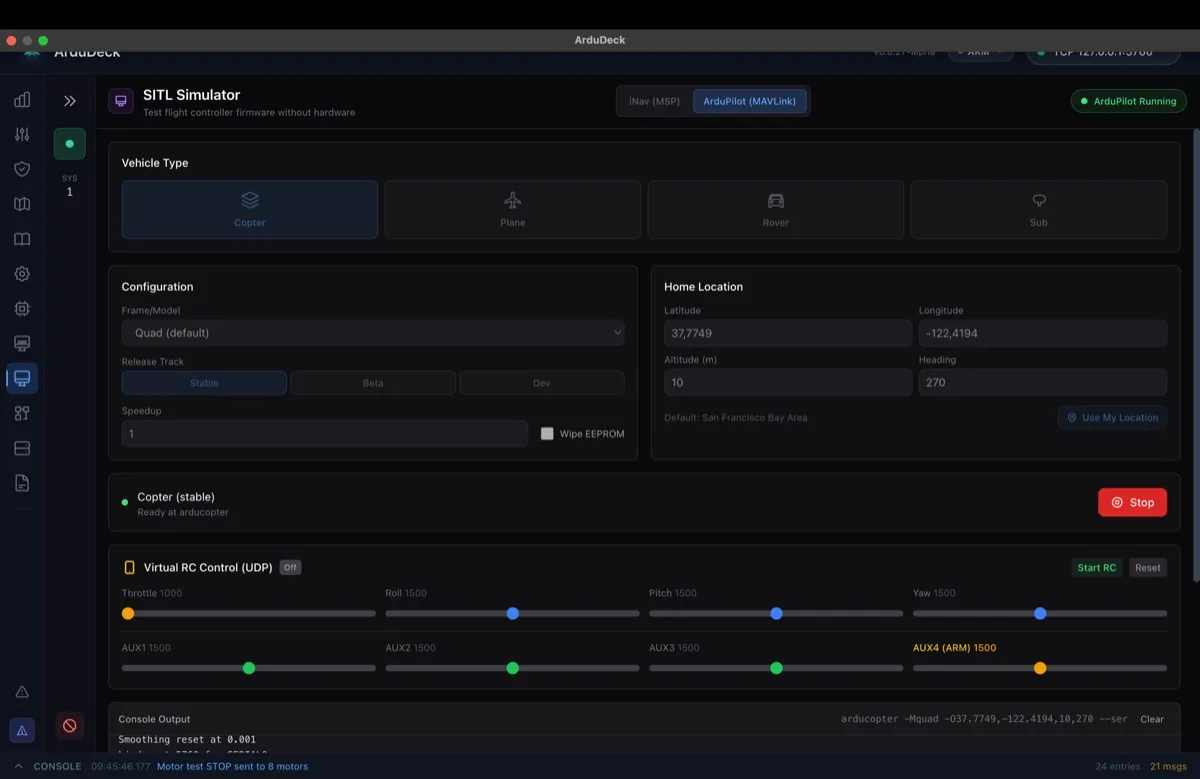
MaameDrone-ArduDeck running against the SITL simulator
MaameDrone-ArduDeckOur ground station handles launch, cockpit, missions and the pre-flight gate, all without RC.
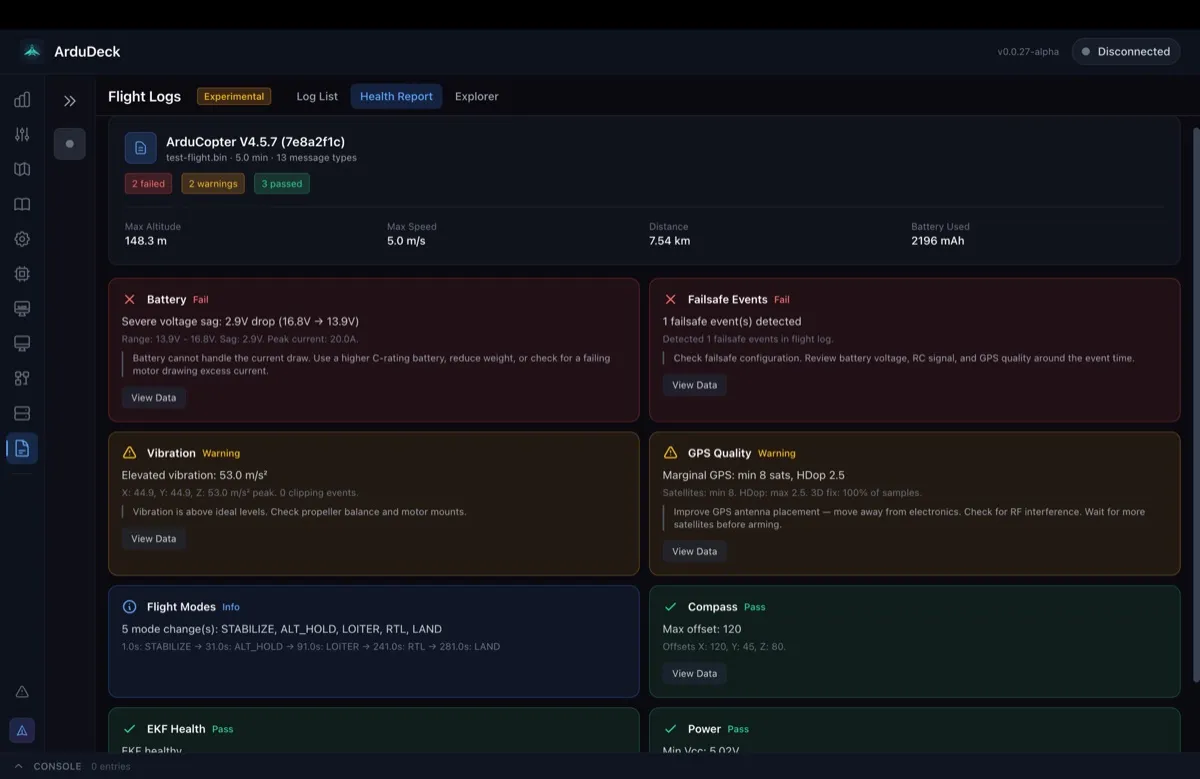
Flight log health report in MaameDrone-ArduDeck
Every flight is measuredVibration, battery sag and hover current from each log feed the next flight's checks.

The mission · FSF

Full
Self-Flying

An aircraft you give a goal, not a joystick. We climb toward it one level at a time, and every level must pass simulation and then the field before the next one starts.

  1. L5 Full Self-Flying Goal

    You give a goal; it plans, flies, adapts to what it sees and lands, with no supervision and redundant sensing.

  2. L4 Beyond line of sight Planned

    Supervised missions over 4G, far past what the operator can see, with remote take-over and alternate landing sites.

  3. L3 Perception Planned

    Camera + on-board AI: precision landing, people and object detection, visual obstacle avoidance, flight without GPS.

  4. L2 Smart Flight In simulation

    The companion computer flies whole tasks (orbit, survey, search, patrol, drop, follow) and brakes for obstacles on its own lidar.

  5. L1 Mission autonomy Done

    Flies planned missions, gates its own launch, handles failsafes and only obeys signed commands. First flight: 16 Nov 2026.

  6. L0 Remote cockpit Done

    A person flies through the ground station or phone. No RC transmitter, position-hold only.

Smart Flight · Level 2

One aircraft,
many jobs

Each Smart Flight task is a flight pattern that a real industry needs. Tap a point on the map and the drone flies it, checks it against the fence and battery, and comes home.

Track · Survey grid L2 · In simulation

Lawn-mower lanes over a field for crop imagery and spraying plans.

Where we're going · mission plan

Three waypoints
to Full Self-Flying

Each waypoint depends on the one before it working in the field.

WP1 · Now In progress

L2 · Smart Flight

  • Tasks, not waypointsThe Pi flies go-to, orbit, survey, search, patrol, drop and follow-me. Every task passes in simulation.
  • Lidar brakeA forward TF-Luna stops the aircraft before an obstacle; ArduPilot avoidance backs it up.
  • Field trialsLow and slow first: 10 m, small fence, one task at a time.

WP2 · Next

L3 Perception · L4 BVLOS

  • Eyes and a brainCamera + AI accelerator on a new carrier board: precision landing and object detection.
  • Flight without GPSVisual-inertial odometry for places satellites cannot reach.
  • Beyond line of sightSupervised missions over 4G with remote take-over.

WP3 · Goal

L5 · Full Self-Flying

  • Goals, not tasks"Inspect this mast", "deliver to this pin": the aircraft plans, adapts and lands by itself.
  • Open platformV2 carrier board for any flight controller, so others can build on FSF.